What Cables Do
Small Parts CarryingA Heavy Load
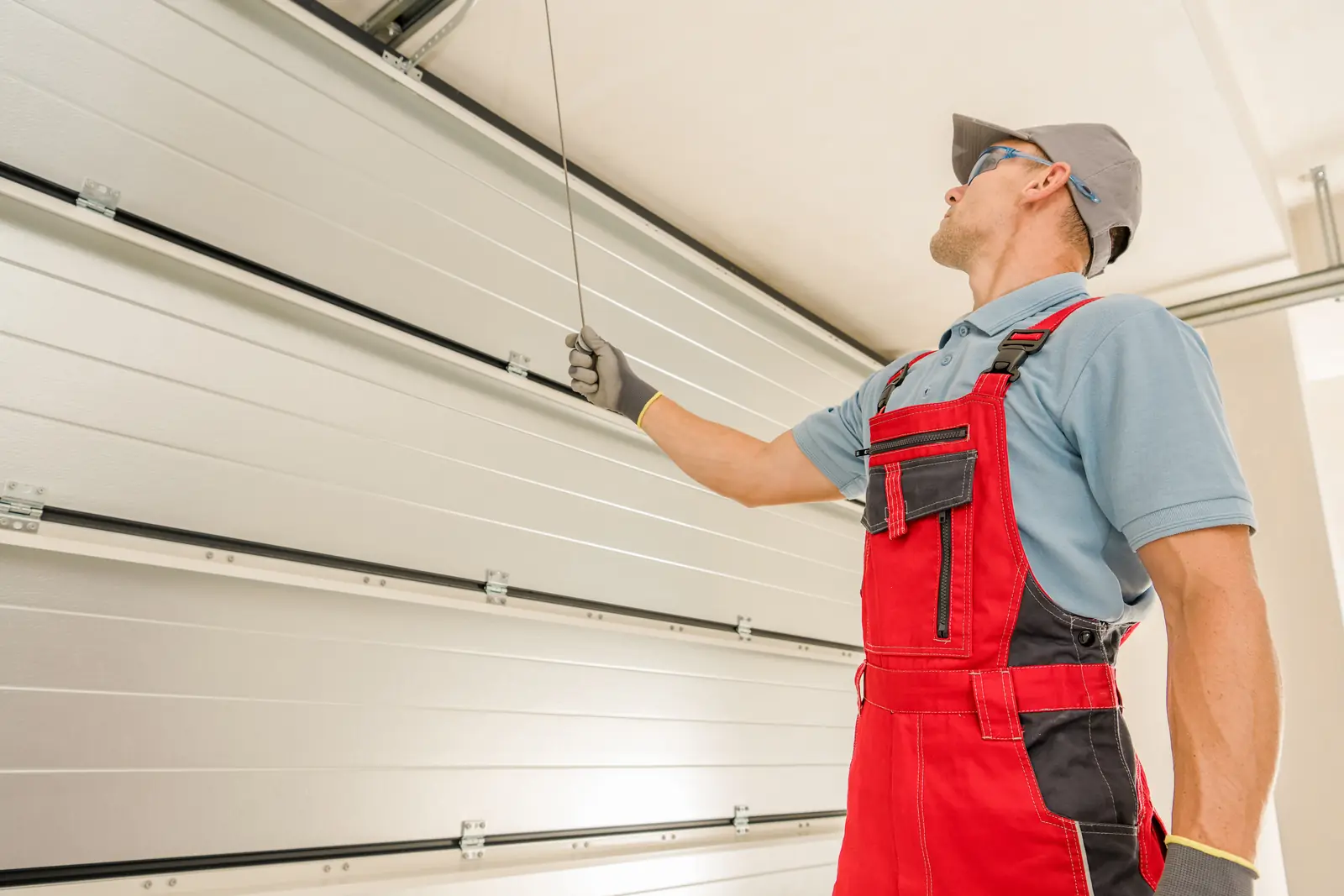
Every residential sectional door has two lift cables, one on each side. On a torsion spring door, each cable runs from a bottom bracket at the base of the door up to a grooved drum on the torsion shaft above the opening. As the springs unwind, the drums turn and wrap the cables, lifting the door evenly from both sides.
On an extension spring door, the cables run through pulleys attached to the stretching springs and anchor to a bracket near the track. The principle is the same: the springs supply the lifting force, and the cables deliver it to the bottom of the door.
Because the cables transfer that force, they are always under tension whenever the door is closed. A typical residential cable is galvanized braided steel, often around 1/8 inch thick, and must be sized for the weight of the door. Heavier insulated and wood doors common in newer Menomonee Falls subdivisions need heavier cables than a lightweight single-car door.
When To Call
Signs You NeedCable Replacement
- Door hanging crooked
- Cable loose or dangling
- Frayed or rusty strands near the floor
- Cable bunched up on the drum
- Door jerks or binds while moving
- Gap under one side of the closed door
Why Cables Fail
The Most CommonCauses Of Cable Trouble
Cables rarely fail without a reason. When we replace one, we always look for the cause so the new cable does not suffer the same fate.
- Corrosion at the bottom bracket. This is the number one cause we see locally. Road salt and slush drip off vehicles, pool at the floor and attack the lowest few inches of cable and the bracket it attaches to. Rusted strands snap one by one until the cable lets go.
- Wear against the door or track. A cable that rubs a roller stem, track edge or panel will slowly saw itself apart.
- Slack cable. If the door hits an obstruction or the bottom freezes to the floor while the opener keeps pulling, the cables lose tension and can jump off the drums.
- Broken spring. When a spring snaps, the sudden loss of tension often throws a cable off its drum.
- Age. Like springs, cables fatigue over thousands of cycles.
Winters in Menomonee Falls are hard on the bottom of a garage door. A quick look at the bottom brackets each spring, after the salt season ends, can reveal rust before it becomes a failure.
Problem Guide
Matching SymptomsTo Cable Issues
Cable problems tend to show up in a few recognizable ways. This quick guide can help you describe what you are seeing when you call.
| What You See | Likely Cause | What To Do |
|---|---|---|
| Door hangs lower on one side | Cable snapped or slipped off one drum | Stop using the door and call |
| Loose cable dangling by the track | Broken cable or spring | Keep clear, do not operate |
| Fuzzy, broken strands near the floor | Corrosion at the bottom bracket | Schedule replacement soon |
| Cable bunched or crossed on drum | Slack cable event | Do not run the opener |
| Door jams partway, rollers bind | Uneven lift from one weak cable | Call for inspection |
A crooked door is the most dangerous scenario. When one side drops, the rollers can twist out of the track and the panels can crease. Running the opener at that point usually makes the damage worse.
Our Process
How We HandleYour Cable Replacement
Assess The Door
We check how the door is hanging, which cable failed and whether rollers or tracks were damaged.
Secure And Unwind
We clamp the door in place and safely release spring tension before touching any cable hardware.
Install New Cables
We install a matched pair of cables and replace damaged drums or rusted bottom brackets.
Re-Tension And Level
We rewind the springs and set even cable tension so the door sits level and lifts straight.
Test The System
We run the door through several cycles, lubricate moving parts and verify the opener's safety reversal.
Safety Note
Cables Are TiedTo Spring Tension
Cable repair looks deceptively simple. In reality, you cannot safely replace a cable on a torsion door without first unwinding the springs, and the bottom bracket that holds the cable is under that same tension. Removing the wrong fastener on a bottom bracket while the springs are loaded can release the bracket violently.
That is why we treat cable work with the same care as spring work. We clamp the door, unwind the springs with proper winding bars, and only then remove the old cable. If your door is crooked or a cable is loose, please keep everyone clear and call us at (262) 555-0123.
It also helps to know what not to do. Do not try to force a crooked door down by hand, do not pull the emergency release on a door that is hanging unevenly, and do not run the opener to see if it will straighten itself out. Each of these can turn a cable repair into a cable, track and panel repair. Leaving the door exactly where it stopped gives our technician the safest starting point.
Our Repair
Replacing CablesThe Right Way
A proper cable repair is more than threading a new wire onto the drum. Our technicians follow a consistent process so that both sides lift evenly and the door stays square.
- Secure the door. We clamp the door in the tracks and safely release spring tension.
- Replace both cables. Cables wear at similar rates, so we replace them in pairs. Matching length and diameter on both sides is essential for an even lift.
- Inspect the drums. A cable that jumped off often leaves burrs or cracks in the drum. Damaged drums go through our drum replacement service.
- Replace corroded bottom brackets. A new cable on a rusted bracket is a short-lived fix.
- Re-tension and level. We wind the springs back up and set equal tension on both cables so the door sits level on the floor.
- Test and adjust. We run the door several cycles, check balance and confirm the opener's force and reversal settings.
Related Damage
Checking EverythingThe Cable Touches
A cable failure rarely affects only the cable. When a door hangs crooked, rollers can pop out of the track, sections can bend at the hinges, and tracks can twist. We check each of these before we call the job finished.
If a roller stem is bent or the wheel is cracked, we can replace it during the same visit through our roller replacement service. Bent vertical or horizontal track is straightened when possible or replaced when the steel is kinked. We also inspect the springs, since a snapped spring is often the reason the cable came loose in the first place. If they are worn, our spring replacement team handles them at the same time.
Prevention
Helping Your CablesLast Longer
You cannot eliminate cable wear, but you can slow it down. A few habits make a real difference in our climate.
- Rinse or sweep away salty slush near the bottom of the door during winter, especially at the corners where the brackets sit.
- Before opening the door on an icy morning, make sure the bottom seal is not frozen to the floor.
- Look at the cables a few times a year. Broken strands, rust or kinks are a signal to call.
- Keep the door balanced. A door that drifts up or down on its own puts uneven stress on the cables.
- Schedule an annual tune-up, ideally in the fall before the snow arrives.
During a tune-up, we check cable condition from end to end, confirm the cables are seated properly in the drum grooves and look closely at the bottom brackets for rust. Catching a cable with a few broken strands is far better than finding it snapped on a January morning.
Local Coverage
Cable Repair ThroughoutMenomonee Falls
We repair cables on doors all over Menomonee Falls, from compact single-car doors on 1950s ranches near Main Street to wide, heavy carriage-house doors in newer neighborhoods off Appleton Avenue and Pilgrim Road. We also serve Germantown, Sussex, Lannon, Butler, Lisbon, Richfield, Brookfield, Mequon, Wauwatosa and northwest Milwaukee.
A crooked or stuck door is an urgent problem, and our same-day repair service can usually get a technician to you quickly. Call (262) 555-0123 and describe what you see.